Tips on Creative Research: Good Research Lets You See Your Story

Library books for my creative research project

“Sometimes it’s not enough simply to peer intently into your own soul. Sometimes you have to look out the window and see the world in all its complicated glory.”

—Philip Gerard; The Art of Creative Research

I remember asking, “What is a trimester?” I blushed when my high school teacher answered me. My ignorance was exposed! How much more should a writer, whose work has the potential to last longer than a classroom discussion, avoid embarrassment by striving to know what he is asking about? To be fair, I was innocently unfamiliar with the term back then. But when it came time to write about an unplanned pregnancy a decade later for a creative writing project in WRIT 402, you bet I began covering my bases by researching the relevant angles, even if they were only peripheral to the narrative details of my short story. I found that the plainest discoveries in research can ignite and support the most authentic, meaningful handling of subject matter in creative writing.

Enjoy these few tips on navigating sources and weaving them into your creative project.

Why research?

You are a writer, but first an observer. A natural observer first, then a committed researcher. A writer applies and exercises their natural inquisitiveness through methods of research.

Research isn’t just about plucking out facts that are out there somewhere. By finding facts, you are researching your story as you form it. That’s what makes research a creative act.

Creativity asks as much as it answers, and research offers its share of asking and answering. It should be an inviting part of the creative process, leading to the discovery of what’s there and to the creation of what not yet is.

“Write what you know,” many advise. It is probably worth adding that we can only write what we know. To write more, we must learn more.

You are writing about something because you care about something. When you choose to write, you owe it to yourself and to your readers to know what you are talking about, to expose yourself to relevant materials on your subject so you can internalize and embed truth into your work with credibility and authority.

For my creative short story in WRIT 402, my plot background is backed by real lives I learned about through research. My plot imagines plausible characters and situations that I can support and defend from the content I absorbed in my research.

In a nutshell, research gathers facts about what things are and how those things relate to other things in the world.

Facing the facts

Facts live before they’re told. They often follow the tracks of a story. Art may imitate life, but life is really the only art there has ever been. Experience is the pen’s early ink.

The sources I gathered for my project ranged from journalists and researchers, health experts and credentialed specialists, to individual testimonies. This gave me a wide range of contexts to pull from. Some of these authors researched their topics from arm’s reach. Others had faced the ferocity of their topics firsthand.

It is good to diversify your sources. One of my sources summarizes a topic from a broad view with many historic perspectives, while another source comes from an author who had personally lived through the topic and gained an uncompromising view. Each kind of source carries its own voice and authority, which can add depth to your own.

You notice different things from different vantages, whether from afar or up close. You can verify one source by comparing it with another. You see continuity emerge. You see the shades of it from all the relevant angles. The light shifts on it from source to source, making a composite impression. Whether colorfully vivid or colorless in the dark, it remains the thing that it is. Everything comes into focus, giving you confidence that you understand the material well.

You probably can’t know everything about a topic. But you don’t have to. You’ll find no end of rocks to look under. But the rocks you do look under you can carry with you.

Look at what’s around you and seek it out. Set your focus and commit yourself to understand what you find.

So how do I find and use my sources?

Sources I gathered for my creative writing project in WRIT 402 included digital media and traditional print literature.

I found my print sources by searching through my local public library system online with topic keywords and authors on my subject. I tried entering different terms and combinations, finetuning searches to yield helpful results. After scrolling through dozens of items in the system, I selected several books and had them delivered to my local library for pickup.

In addition to public libraries, academic databases are usually available to college students. They include professional journal articles as well as published books and other items that you can find online or on campus. Consider every research option that may be available to you. I should also mention that I supplemented my library use with online access to materials through Hoopla and Google Books.

In the digital age, a lot is available besides print literature. Several podcasts, webposts, and a university lecture webcast were integral to my research. So was an analog pocket radio, too! Your topic lives in many bandwidths.

You hear people say, “Oh, I saw it on the internet.” But that answer says nothing about where they actually saw information. Online material is made up of webpages that are uniquely identifiable just like published literature, encompassing a massive variety of formal and informal content. Many online sources helpfully cite the sources that they use. The Modern Language Association of America offers good criteria on how to identify sources on their Works Cited guide and elsewhere.

How do I know what’s credible?

Published works are generally vetted for quality before going to print, and nonfiction books often provide their sources in footnotes or a bibliography in the back of them. You can cross-reference information, drawing comparisons in their logic and thought-forms, rubbing sticks together to make a flame.

Bias—a particular stance for something—isn’t necessarily a bad thing. You just have to know when it’s there, what to do with it, and how it relates to your subject as a whole.

Whether online or anywhere, look for competence and a sense of ethical trust. In my research, I discovered The Seth Gruber Show as a solid source thanks to the daily Moody Radio program, In The Market with Janet Parshall.

Contested ‘arguments from authority’ hinge on what’s inside. Critically read between the lines while also trusting them, letting your sources earn your trust. Truth is there, whether buried or unsurfaced. So put your sensors out. Investigate the material that is touching your topic.

Living with the facts

Let your research speak to you, but also speak to it. Decide when to let it guide you and when to guide it by guarding your focus. Discern when your attention should linger or move on. You may find that you will spend more time on some sources than others.

Some sources were a guiding center for my story while other sources helped round out the edges. I spent most of my time on those sources I found to be the most important to the narrative details of my story. But they all were beneficial to me in some way.

You do not have to read every word of your research contents. I sure didn’t. Holding a book in your hand for a few minutes can do a lot for you, giving you a solid impression of the subject. If you can’t read everything, you can at least look at chapter headings and skim key passages. Or you can spend a whole night reading a book cover to cover if it’s crunch time. Pace yourself however is best for you and your project. Learn as much as you feel you should. Honor your sources by taking the time to really understand them, to live and ‘talk’ with them.

Examples of writing from research in my short story

Research can confirm your preconceived assumptions about your topic or offer nuanced redirection.

“A teenager who finds out that she is pregnant may want to terminate a pregnancy because she feels that she is too young to have a baby,” says the research writer of Critical World Issues: Abortion (Walters, p. 53). That is exactly the rationale for why the protagonist in my story admits, “I wonder about abortion.” My protagonist then explains what she expects from life at that vulnerable time.

Pictograms of fetal development from conception to birth appear in a chapter on “The Question of When Life Begins” (Walters, pp. 29-31), encouraging a line in my story about how millions of sperm cells “raced to become a zygote, then a fetus, then you and me.” My next sentence, “There’s another heartbeat inside you even now,” is affirmed by an article from Medical News Today that considers when a fetus’ heartbeat is detectable.
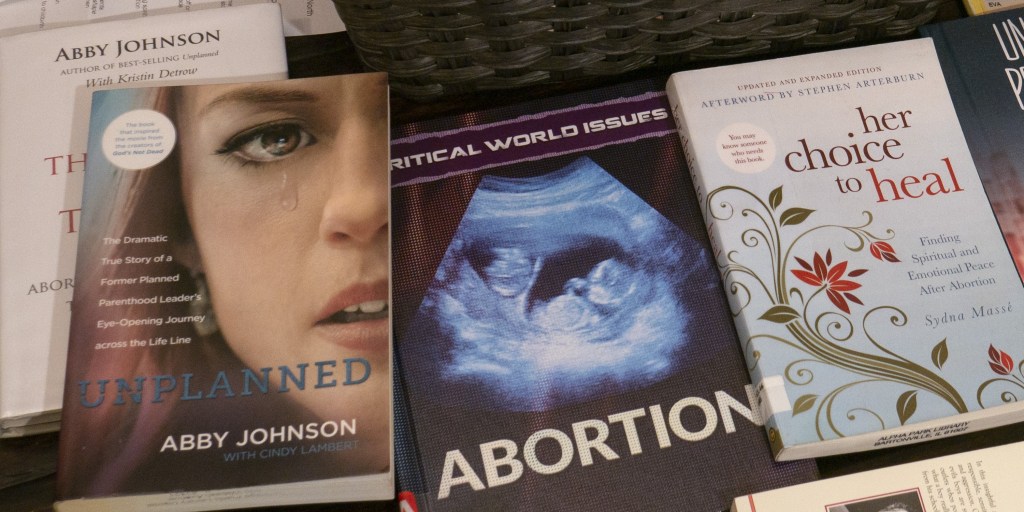
Books by Abby Johnson, Mike Walters, and Sydna Massé

Before I read Abby Johnson’s groundbreaking book, Unplanned, I assumed abortion clinics never showed ultrasounds to women. But a discovery in her book corrected me. At the abortion clinic Johnson had directed, most women declined to see an ultrasound (Johnson and Lambert, p. 46). So that meant some abortion clinics do show ultrasounds. This led me to rework some dialog in which one character begs my protagonist to see an ultrasound while indicating that there are medical alternatives like the Destiny for Women Health Clinic and Empower Life Center in my hometown, Peoria, IL. This research discovery also led to one of the subtlest moments of sharp emotion later on in my story.

The facts you find in research go hand in hand to form the emotional thrust of your story.

Fact and form

So, should you mention everything you learn from research in your story? No, not every detail is going to make it in, but everything you do learn contributes to your mastery of the subject. It sharpens everything you do include. Experienced writers will tell you: It is good to know more than you have to use. Our eye hits a focal point, yet everything around it is what makes up most of our vision. That’s the periphery of things, and the quality of researching for writing.

Do I mention as fact in my short story that abortion is known to occur in virtually every socioeconomic demographic? No, but I do narrate the lives of a struggling teen from a bad home and an accomplished university professor who’d both faced unplanned pregnancy in late-modern America. Facts add up to form the whole. They’re how a scene and situation gain life and substance in your story.

The filter that separates truth from error in your work should be you, the author. Research is a responsibility. It is discernment and care. Listen to the facts you find. Hear how they breathe along with your ideas. You can create something honest and credible when you are honest to your intuitions about the topic while caring about others who’ve experienced the topic.

If you are writing fiction like I did, you can include an Author’s Note at the end of your story to credit your sources and describe how they helped inspire you. Just be careful that your work is original. It should be your story. Your story simply shares the same universe of others’ experiences, especially if you’re writing for realism like I did.

It is up to you to find out how research can weave in and out of your ideas, to strengthen the integrity of your ideas, growing who you are as a storyteller.

Writing is the great challenge of peering just past the horizon while never dashing too far from home. Your discoveries may only be as far away as your local library or someone knowledgeable you know who can speak into your topic.

Research is a necessary and exhilarating part of the creative process for any creative writer venturing to write about things that matter. Step out. See what’s out there and inside you.


Links

  • Hoopla | Containing thousands of books and other media, this resource is free and connects to the public library system.
  • Google Books | Google Books is useful for previewing content online, reading synopses, and getting a feel overall for a work in digital print. Most published books can be found here.
  • Works Cited: A Quick Guide | The Modern Language Association of America, commonly known for its MLA style, has been an academic authority on writing for over 140 years.

For Further Reading
The Art of Creative Research: A Field Guide for Writers by Philip Gerard (University of Chicago Press, 2017). Practical and poetic, this book is a step-by-step guide and a memoir of sorts on writing research. A great read that relishes the shape and approach of one’s writerly identity in the field.
The Christian Imagination: The Practice of Faith in Literature and Writing by Leland Ryken (Waterbrook Press, 2002). A moving collection of insights and essays from some of history’s greatest writers. “The more we learn about ourselves, the deeper into the unknown we push the frontiers of fiction,” wrote Flannery O’Connor.


Works cited in this post

Anna Smith Haghighi. “When does a fetus have a heartbeat?Medical News Today. 29 Jan 2024. Healthline Media UK, 2024.

Abby Johnson and Cindy Lambert. Unplanned: The Dramatic True Story of a Former Planned Parenthood Leader’s Eye-opening Journey Across the Life Line. Tyndale House Publishers, 2014.

Philip Gerard. The Art of Creative Research: A Field Guide for Writers. University of Chicago Press, 2017.

Mike Walters. Critical World Issues: Abortion. Mason Crest, 2017.

‘Vindicating Trump’ is Year’s Most Important Movie

Movie poster outside local theater

Vindicating Trump is easily the most important movie of the year, exposing how dangerous and corrupt much of established institutions have become in light of the political persecution endured by President #45, Donald J. Trump, perhaps the most publicized man in history. I call the movie the most important of the year because of what it represents. It is more than a movie and it is bigger than Trump (though central to him at this present moment).

“Blow, blow, thou winter wind, / Thou art not so unkind / As man’s ingratitude,” one can reflect on pop culture’s distaste for the man whose policies benefit the futurity and security of U.S. sovereignty and the world.

Director Dinesh D’Souza sets out to clarify the “enigma of Trump,” observing that some have sought to “sidestep the enigma of Trump the man by saying, ‘I don’t like him, but I like his policies.’ Yet if Trump’s critics are right that he is an aspiring tyrant, a dictator, something akin to Hitler circa 1933, it is the man—not the policies—that matter most.” Thus, the man also breeds the policies. In D’Souza’s new book by the same name, Vindicating Trump, the investigative writer-director asks, “If Trump isn’t the one imposing a tyrannical regime, then who is?”

Vindicating Trump affirms the view that the U.S.A. has slowly been overcome by corrupt forces on many sides, and Trump, unlike many, took notice to peerlessly rise to the challenge, choosing to do something about it, to stand up against the behemoth on the world stage without flinching. The film adroitly alternates between documentary narration, interviews (with Trump and others), and satirical drama. With imaginative realism, D’Souza as narrator likens Trump to a cowboy riding into a Western town overrun by gangsters.

During this month’s Vice Presidential debate, a courteous yet uncompromising J. D. Vance admitted that he had once bought the media lie so widespread about Trump, a view more easily held before the candidate of “common sense” and moral strength proved a four-year success as President.

I remember the tension of 2016. Way back in the beginning, I was torn. Although I settled on who to vote for, I still wondered who I could fully believe. In 2016, I respected Trump supporters and their liberty-loving patriotism, but was confused by how the ‘respectable establishment’ could so doggedly oppose him unless they somehow had a point. The never-Trumpers vowed for virtue, after all. Today, a barer landscape shows a starker and clearer eyed reality. Since Trump left office after a whirlwind 2020, it is harder to deny the world we are actually in. In this critical hour, no room is left to sustainably breathe the excuses and lies of the ‘blind leading the blind.’ Trump has probably been the sanest person in the room on more than one occasion. The sanest man in the room can appear to be the craziest, especially if outnumbered by adversaries.

Sure, Trump is known to say ridiculous or absurd-sounding things, and enough ink is spilled over it when we happen to find ourselves in an absurd and dangerous world whose evils demand adamant course correction from a leader brave enough to acknowledge and confront the ridiculous. In the twenty-first century, political gangsters sit in offices of ingenuine civility. “I could sure use a mean tweet and a $1.75 gas right now,” a bumper sticker in my hometown reads.

Unlike the local perils of a Wild West town, Trump has accrued enemies from all over the world—enemies of freedom and American dignity. Take the past decade, or even the past four years, where we have seen political cronyism warped to transform culture through radical ideology aligned by intrigue, bent on controlling hearts and minds under ill-intended concentrations of power. Many leaders have ridden the coattails of the Founders’ words while abusing everything they built. “It’s hard to be nice when they’re destroying our country,” Trump has said.

Corruption is an inconvenient fact, a real threat to every responsible person. It is easy to dismiss only because we have for so long had it so good, unlike other (older) populations in the world who lived to see the end of where radical ideologies lead: the loss of national freedom and individual prosperity. In a word, tyranny under centralized government. Is this so far-fetched? Only if you are unwilling to look beyond the moment. D’Souza and his topic, Trump, do.

“He could be a tyrant, if he wanted to. But he doesn’t want to,” says D’Souza. “Rather, he wants to use his immense charisma and power to mobilize the American people against the forces of tyranny and repression, coming from the Democrats and from the Left.”

The film gives viewers front row access to intimate interviews that show a humanizing side to Trump seldom celebrated, also effectively satirizing the sort of shady, backroom dialogs that go on behind closed doors among the political movers and players of public opinion. The documentary’s true-to-life realism is paired with skit-like, dramatic segments, a creative and daring choice by D’Souza, humorous but harrowing while satirically cathartic, encouraging the viewer—through the free speech mechanism of film—to laugh at those circus aspects of things while also recognizing, accepting, and not shirking away from the gravity of things, of the fight for freedom on the modern stage.

D’Souza follows the line, as do I, that Trump’s virtues far outweigh his vices, and that his trademark toughness is exactly what is needed at this hour. A roar for law, order, and traditional American values to return nationwide, to undo the damage caused by the radical governance of would-be, quasi-dictators at a helm buttressed by media conglomerates and offshore bureaucracies. Several seconds of a sit-down interview with Trump supplies more truthful sentiment than the entire careers of some politicians. “They have bad policies, so they cheat,” Trump says of the radical goliath.

We owe D. J. T. a sincere debt of gratitude if not a monumental apology. Many do not know how blessed they are to have a Trump straddled in the boxing ring of world affairs. Certain heroes are rarely uncontroversial before the dust settles.

After I saw Sound of Freedom (2023) perversely denigrated by much of the press last year, I no longer expect the press to be remotely decent. Cheap lies are a dime a dozen, bought by the brokers of world greed lusting after their idea of empire. The billionaire Trump, once worshipped in newsstands, is now the target of multinational crucifixion. Perhaps a ‘Benedict Arnold’ in the eyes of global barons funneling resources to nation-usurping ideologues.

Do not be surprised if this movie is ridiculed by what I call the ‘deep creep.’ The masks came off completely when Sound of Freedom was derided without cause last year, to name just one example of wanton mastheads breaching civic and humane normalcy. Also do not be surprised if this movie is met with tentative indifference.

The movie affirms what Trump voters have already known while offering powerful testimony to those who may find themselves unsure, perplexed by the polarization of the times, or possibly stuck somewhere in the middle between traditional values and the radicalism couched in popular culture by parroting peers and gatekeepers (who like borders, just not national ones).

“I have never met a woke person who is happy,” said Trump while interviewed by D’Souza. “That’s true,” I heard a woman say while viewing the film in the theater along with the handful of others who were there.

Many are subtly trained to be “unbiased” in an unnatural sense, as though political neutrality were the same thing as objectivity, and most consequentially, as though neutrality were the most peace-enabling option to respect civility. The MAGA movement—as led by Trump—has sought to reclaim a vision for genuine civility by “telling it like it is,” without compromise or pretense over fundamental matters that are life or death for the free American, to preserve core values and principles—our strength and the world’s—once undisputed in the U.S. not very long ago.

We are at a life or death crossroad for the greatest nation on earth. Trump, unlike most, has taken a stand in the line of fire. He took a racing bullet for his beliefs. Welcome back to history as usual, where good men are shot at. We The People ought to win this while it’s easy.

One point made by the film is that paper money is more secure—against counterfeiting and such—than the election system is. Shockingly, or not so shockingly (to those paying attention), the election system is believed to be profoundly insecure. The movie goes into startling detail on this. Trump urges Americans to vote “too big to rig.”

Those that love life—their homeland, family, and God—have not picked this fight. When a person loves life, they do well to defend it. It’s how we’re here, and can keep on. Vindicating Trump affirms that perseverance can curtail corruption. The bravery of one powerful man against the spheres stacked against him then rings loud and clearer in the media din.

This movie is well done, hard yet encouraging to watch. It is a must-see.

Now is a fateful hour. The Liberty Bell sounds with alarm.

“Everyone should be in here to see this,” a man said to me as closing credits rolled with the startling reality check: The times we’re in are not fiction or ‘business as usual.’ The task of preserving liberty has always been the business of the real American, a business we had better get back to if we are to keep our way of life.

To anyone that cares, go see this movie on the big screen. Tickets aren’t likely to get any cheaper unless Trump is indeed vindicated.

Introducing Space Prairie

See video above: Introducing Space Prairie (Act I epilogue) by Wes Brooks. (2 min.)

Hi there, I’m Wes. The entire film, both Act I and Act II, is already shot. We filmed it way back, mostly in the summer of 2015 on dozens of video cassettes with an ensemble of dear friends. I’ve been editing ever since. (Look close and you’ll see steam coming out of my ears.) If you enjoyed Act I, thank you dearly. It means a lot that you’ve seen it after a decade of work.

Now, if you really enjoyed the film, and you’d like to see the total fulfillment of our Space Prairie tale, hop over to spaceprairie.com and consider making a donation to help spur these characters through their glorious adventure toward the beautiful destinies already prepared for them. Again, it’s all been shot, and it’s just a matter of clicking away at what is nearly finished. Phew, it all takes time… I learned that the hard way.

Ever since I began writing as a teenager way back in 2013, it’s all been for the verve and the joy of giving you a uniquely expressive cinematic experience—on a less-than-shoestring budget, but with an exceedingly sincere love of life and creative wonder.

See the film:

Synopsis

A traveling taxman lands on a prairie world colonized by a cantankerous pioneer farmer. They quarrel over money matters until their affections for the Angus family daughter leads to a brawl. Meanwhile, two heavy-hearted settlers sight a troubling anomaly in the starry skies above their prairie home.

Filmed on dozens of video cassettes, Space Prairie began on paper in April of 2013 and was mostly filmed in the summer of 2015 by an ensemble of high schoolers in the Midwest, involving fifty days of principal photography followed by a gargantuan post-production. A decade in the making.

Please consider making a donation as a ‘Thank You’ for your digital seat. A donation of any amount will go toward the cost of Act I, encouraging the completion of Act II.

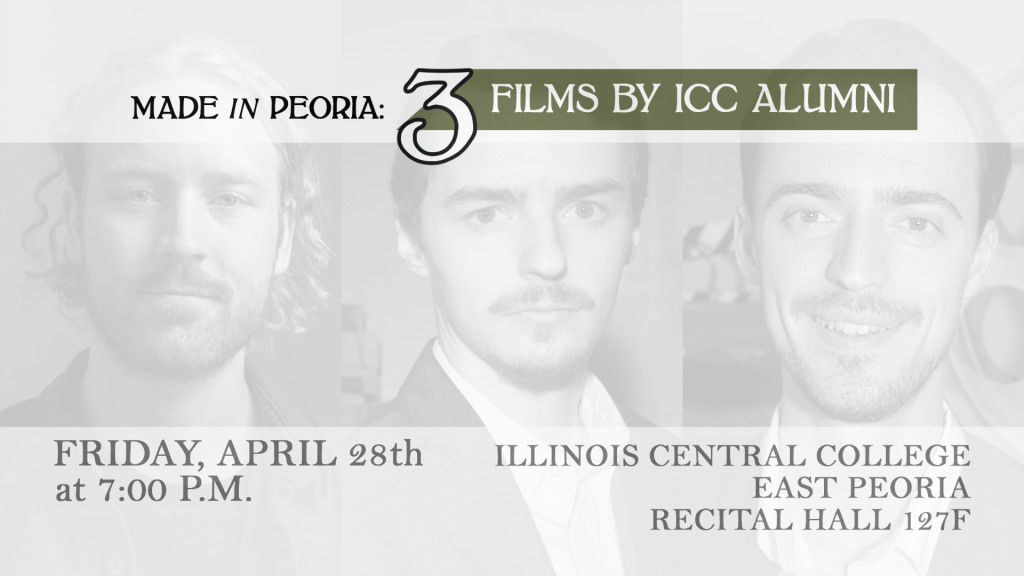
Made in Peoria: 3 Films by Filmmakers of the Heartland (ICC Alumni) on April 28, 2023

Learn more about our screening event, Made in Peoria: 3 Films by Filmmakers of the Heartland (ICC Alumni), on April 28th, 2023.

Get tickets: https://www.eventbrite.com/e/3-films-by-icc-alumni-made-in-peoria-tickets-598796044087

Facebook event page: https://fb.me/e/VHBc8HDh


Article

On Friday, April 28th, Peoria-based filmmakers and arts alumni of Illinois Central College will show three of their original films for a one-time screening at 7:00 P.M. at the East Peoria campus of ICC in the Lecture/Recital Hall, 127F. The evening begins with Moving Through the Day by John Voss, a summer stroll showing off Peoria’s beloved Donovan Park. Then, William Jacobs of Mourning Dove Films screens a selection from Poet in a Modern World, an artistically rigorous story about finding purpose and clarity. Finally, Wes Brooks screens his feature-length family adventure, Space Prairie, a large-hearted epic that took a decade to make.

Filmmakers John Voss, William Jacobs, and Wes Brooks attended Illinois Central College for several years while working on their movies. “It was a precious time,” recalls Brooks, who attended the college with Jacobs from 2015 through 2020. “I met Will on campus and followed him around, hoping he’d like my work as I marveled at his. We have enjoyed a collaborative bond since those early days of cranking out coursework while fighting those battles to stay creative. It’ll be a treat to showcase our corner of regional filmmaking at the place where so much of it began for us. A lot has happened in the world since we graduated in 2020, so I hope Peorians latch onto the kind of lyrical storytelling that we hope will be life-giving to moviegoers in April.”

“The Heartland needs a voice,” says Jacobs, founder of Mourning Dove Films. “What audiences will see at this screening is a glimpse of what is possible when filmmakers remain creating in the Midwest, untrammeled by politics and groveling studio executives. We are offering what Hollywood isn’t—beauty and heart. These three films are made by ordinary people who care for and love ordinary things. Building alternatives is no easy feat and so we hope that our projects receive the necessary support for the continuation of beautiful cinema made in Peoria.”

A Moment Is Enough, Space Prairie: Act I, and Moving Through the Day

Brooks began writing Space Prairie when he was sixteen, two summers before filming and starting college. “After years of health issues as a child, I began to heal as a teenager and wanted Space Prairie to be a joyride for us, a production journey that felt like a Sunday afternoon drive in a roofless car—a gleeful breeze blowing through us beneath puffy, sunbaked clouds. Alongside the enormously absurd effort we put in, that’s exactly what it was: a gift of healing and creative fulfillment for us.” In Space Prairie, an interplanetary taxman and a pioneer family sight a troubling anomaly in the starry skies above their isolated prairie world—a whimsical and epic tale of romance, robots, and the will to survive.

“I feel as though, for the very first time as a filmmaker, I am finally making a film,” reflects Jacobs after completing A Moment Is Enough, an ascetically demanding project created on 16mm film, an excerpt of the feature-length Poet in a Modern World, a story about “choosing Beauty in a world defying it,” now in production in Peoria. “What we experience in cinema ought to clarify the common linkage between us as human beings struggling to exist in this world as spiritual creatures—the very things that go beyond mere politics, celebrity, and social media,” says Jacobs. “It is beauty that binds us as a civilization; it is beauty that calls us to be more than what we are.” While filming in a “stifling and cramped room,” Jacobs lauds “what cinema really is: an edifying expedition into time.”

“Peoria is my home,” reflects Voss. “I’ve continued to find myself and so much beauty in it, primarily in its landscapes and its people. Moving Through the Day features my beautiful girlfriend, Taylor, spending a day in Peoria’s picturesque Donovan Park. I believe films are a place where modern myth flourishes. We’re all figuring out how to navigate reality with everything we do, including art. Over time, by using film to express myself through inspired images, I’ve further understood who I am and things I’m processing or ‘moving through.’ You could say that Moving Through the Day is a confrontation with the passing of the day and an expression of my love for a couple of things that I find a home in.”

General admission is $15, family and group admission is $8, and children’s admission is $5. Bring your family or a group of friends, and tickets are $8 for each person in your family or group. Tickets for kids 12 and under are $5.

The films are suitable for any audience.

Get tickets: https://www.eventbrite.com/e/3-films-by-icc-alumni-made-in-peoria-tickets-598796044087

Facebook event page: https://fb.me/e/VHBc8HDh


Trailers

Explore more: https://linktr.ee/3filmsinpeoria


Hop on the bandwagon